Enterprise Test Data & Privacy Automation

Accelerate delivery with production-grade test databases Classify, mask, and provision safe ephemeral data inside your VPC in minutes

Ark unifies privacy classification, intelligent masking, relational subsetting, and ephemeral test environments into one automated platform. Empower developers with realistic data while guaranteeing sensitive data never leaves your VPC.

  • Continuous PII detection across columns, unstructured text, and nested JSON
  • Intelligent masking and relational subsetting that preserves database integrity
  • Continuous drift tracking that auto-updates classifications as schemas evolve
  • Snapshot-based data virtualization and self-service ephemeral databases for CI/CD, QA, and debugging
  • Governed Business Objects plus deterministic Anchors for repeatable, scenario-ready test data

Read-only credentials or a replica — never write access to primary production.

Platform

Classify -> Mask -> Subset -> Provision

Deployment

SaaS orchestration, in-network execution

Outcome

Prepared test databases that stay aligned with production change

Entry points

Meet each team at its point of friction

Ark creates value before a full rollout. Different teams can enter from the same platform using the workflow they already own.

Engineering and QA

Give developers realistic data on demand

Provision relational, production-like databases through automated configs that are fast enough for CI and faithful enough for debugging.

  • Use ark-cli or SDKs inside local runs and automated pipelines
  • Stop waiting on stale shared staging refreshes before testing starts

Security and privacy

Review data risk before it spreads into lower environments

Classify sensitive fields, enforce masking, and keep reviews current as database changes introduce new risk.

  • Keep raw rows in-network with the outbound-only VPC agent
  • Inspect masking coverage, residual findings, and newly detected schema changes

Platform and DevOps

Turn non-production data delivery into a self-service platform

Standardize how teams request prepared environments so lower-environment data stops depending on manual tickets, slow dumps, and stale configs.

  • Promote approved configs into repeatable provisioning workflows
  • Track schema drift and refresh classifications before pipelines break

Supported source databases

Ark ships with first-class PostgreSQL and MySQL support today. We only list engines that are available in production.

Available now PostgreSQL postgresql
Available now MySQL mysql

Additional engines are on the roadmap — ask us if yours is a priority.

Direct Contrast

Why teams choose Ark over manual data workflows

The challenge isn't just copying data—it is managing privacy compliance, schema drift, high operational overhead, and delivering realistic test data reliably.

Legacy

What teams fight today

  • ×
    Ad-hoc tooling and manual maintenance

    Each team solves test data differently with disjointed tools, incomplete masking, and tribal knowledge that breaks with every schema change.

  • ×
    Schemas change, workflows drift

    Database changes quietly invalidate masking rules, classifications, and prepared environments unless someone notices and repairs the flow by hand.

  • ×
    No shared operational model

    Engineering wants speed, security wants control, and platform teams are left connecting separate tools without one configurable system of record.

Ark

What Ark changes

  • Automated, policy-driven workflows

    Define how classification, masking, subsetting, and environment delivery should work once, then reuse the same approved flow across teams and pipelines.

  • Drift detection and continuous classification

    Track schema changes, re-run classification where needed, and keep masking logic current as production databases evolve.

  • Unified orchestration with local execution

    The control plane standardizes policy and job handling while the VPC agent runs the data work where your systems already live.

Feature Catalog

One platform for engineering, security, and compliance

Ark connects the teams that request test data, the teams that protect it, and the teams that keep workflows current as databases change.

Referential Integrity Subsetting

Slice large databases while maintaining foreign key relationships so tests never crash on missing relations.

Governed Business Objects

Model reusable domain slices such as Customer, Order, or Claim with a root table, parameterized filters, table roles, virtual relationships, and versioned definitions.

Deterministic Scenario Anchors

Apply version-pinned, parameterized SQL fixtures after subsetting or provisioning so every test environment starts with the exact states your test suite expects.

CLI-First Automation

Seamlessly trigger masked ephemeral test databases directly in your CI/CD pipeline or local developer shell.

Typed SDKs (Go & JS)

Programmatically automate test data provisioning directly inside internal platforms or custom developer portals.

Testcontainers & Docker

Spin up temporary Postgres, MySQL, or Mongo targets using local containers and populate them with safe subsets.

Data Virtualization & Golden Snapshots

Freeze approved masked baselines once, then reuse them as fast copy-on-write clones for repeatable QA, CI, and demo environments.

Developer Workflow

Fits the workflows your teams already have

Start with ark-cli for fast operator execution, then use Go or JavaScript SDKs when provisioning belongs inside platform code, test harnesses, or internal tools.

ARK CONSOLE
MODE INTERACTIVE LANG bash
FILE: TDM-WORKFLOW.SH LANG: BASH
1 # authenticate once
2 ark-cli login \
3 --api-url "https://control.ark.dev" \
4 --api-key "$ARK_API_KEY" \
5 --tenant-id "$ARK_TENANT_ID"
6
7 # inspect available source configs
8 ark-cli configs list
9
10 # provision a masked ephemeral database
11 ark-cli testenvs create \
12 --config "550e8400-e29b-41d4-a716-446655440000" \
13 --wait
14

Product Proof

The control plane is built for real operators

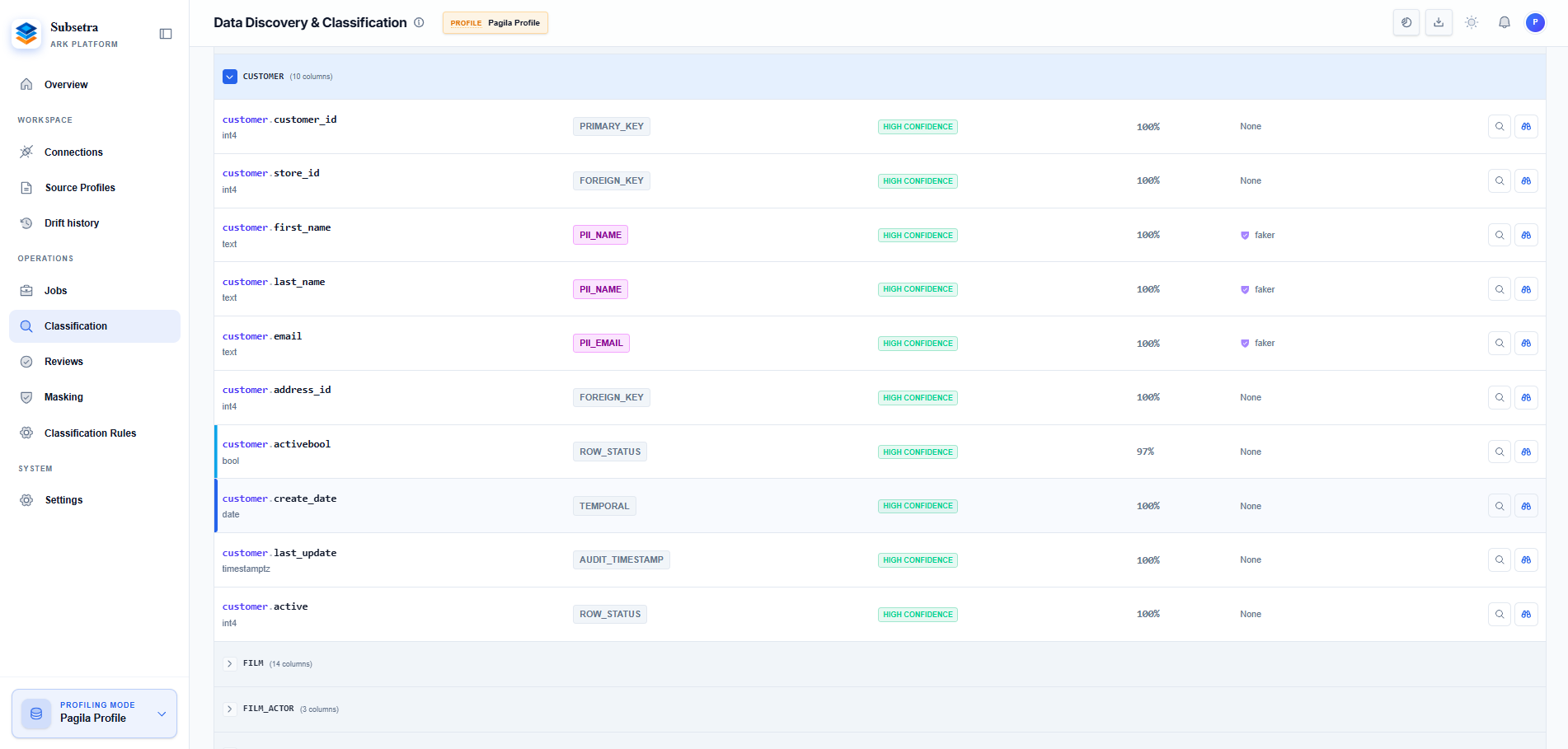
The UI is not a demo shell. It is where teams review classifications, approve masking policy, track jobs, and manage prepared environments.

Classification reviewMasking policiesJob trackingTest environment lifecycle
Ark Control Plane
1 / 53
Control panel snapshot Snapshot 1

Security Architecture

Zero-trust data flow, simplified

Ark keeps orchestration centralized while execution stays close to the source data inside your environment.

A Live orchestration flow

Orchestration loop

B Trust boundary model
Ark SaaS

Metadata Isolation

Our SaaS never sees your actual row-level data. Only schema metadata and job statuses are tracked.

  • Auth & RBAC
  • Job scheduling
  • Compliance logs
  • Policy & metadata
stores ark-meta · audit · policies
Your Private Network (VPC)

Safe Agent Model

Runs as a stateless container in your VPC. No inbound ports required; no persistent data storage.

  • AI classification
  • Local masking
  • DB subsetting
  • Test environments
stores raw rows · masked dumps · sandboxes
Production access, on your terms

Connect the agent with a read-only database user, or point it at a production replica instead of the primary. Ark only needs SELECT-level access to build subsets — write access to production is never required.

Raw production rows never cross this line Governance metadata flows upward

Why Ark

Why teams operationalize test data with Ark

Ark reduces manual handling, tightens data boundaries, and gives mixed technical teams a repeatable, drift-aware way to prepare non-production data.

Risk

Reduce unnecessary PII exposure

Move away from raw production copies in shared lower environments. Ark identifies sensitive fields, applies masking, and keeps the riskiest handling steps out of manual workflows.

Delivery

Shorten environment setup cycles

Give engineers relational, production-like datasets ready for CI, QA, and debugging in minutes—completely safe and automated.

Governance

Make compliance review operational

Map discovered data into governance workflows so privacy and security teams can review what matters without reconstructing context from fragmented logs, tickets, and spreadsheets.

Trust Boundary

Keep execution close to the data

The control plane orchestrates jobs, but the agent runs classification, masking, and subsetting inside your network boundary.

AI Control

Adopt AI without sending data to external APIs

Ark's classification pipeline can run with local models so teams can use automation while keeping sensitive context under their own control.

Auditability

Create an audit trail teams can actually use

Job history, approvals, configuration changes, and drift-triggered updates are visible in one place, making reviews and incident follow-up simpler.

What changes after rollout

Provisioning flow
Manual refresh tickets Repeatable self-service requests
Lower-environment data
Full or stale copies Masked, scoped datasets
Review model
Scripts and spreadsheets Shared control plane

Ark helps teams move faster with realistic data, while keeping privacy controls part of the delivery path instead of a cleanup step.

Knowledge Base & FAQ

Test Data Management Essentials

Key answers on how Subsetra Ark automates relational subsetting, in-VPC masking, and ephemeral test databases.

What is Test Data Management (TDM) and why is Subsetra Ark different?

Test Data Management (TDM) is the discipline of creating, masking, subsetting, and provisioning realistic database environments for testing and CI/CD pipelines. Subsetra Ark modernizes TDM by running a lightweight, outbound-only agent inside the customer VPC. This eliminates the need to upload sensitive production data to third-party clouds or endure multi-hour database restore delays, enabling developers to spin up secure, masked, production-like test databases in seconds.

How does Subsetra Ark ensure zero production data leaves our network?

Subsetra Ark separates control plane metadata from data plane execution. The ark-agent runs entirely inside your private VPC/network, performing discovery, masking, subsetting, and sandbox provisioning locally. The agent connects to the control plane via an outbound-only mTLS gRPC tunnel — raw database rows, credentials, and customer data never leave your firewall.

How does Ark maintain referential integrity during database subsetting?

Ark uses a graph-based relational subsetting engine that automatically traces foreign key relationships, handles circular/cyclic dependencies, and supports composite keys. When subsetting by root business entities (e.g. active users or specific tenants), Ark guarantees that all related parent and child rows are included without breaking constraints.

How can developers and CI/CD pipelines provision ephemeral test databases?

Using the ark-cli command-line tool (e.g. `ark-cli testenvs create --config <ID> --wait`) or native Go and JavaScript/TypeScript SDKs, CI/CD pipelines can provision pre-masked ephemeral database containers on demand, run integration tests against a realistic DSN, and automatically destroy the sandbox via TTL expiration.

How does Subsetra Ark compare to legacy Test Data Management platforms?

Legacy TDM platforms (such as Delphix, Informatica, IBM Optim) require heavy infrastructure, long rollout cycles, and complex manual scripts. Subsetra Ark provides a modern, developer-first alternative: a single Go binary agent, continuous schema drift reclassification, deterministic scenario fixtures, and instant copy-on-write data virtualization.

Deployment Ready

Adopt a safer path for non-production data

Start with one source, one approved config, and one ready sandbox. Then expand the workflow across CI, QA, and internal engineering use cases.

Enterprise-Grade Security & Compliance

SOC 2 Type II ReadyGDPR CompliantKVKK CompliantHIPAA CompliantISO 27001 Aligned

Ark operates 100% inside your secure VPC. Your actual row-level data never leaves your private network perimeter.

entr